
It’s loud, it’s chaotic, and it’s the stomach of Split.
The Split green market — known locally as Pazar — is where the city really starts its day, with farmers, fishermen and cheese sellers setting up from dawn just outside the Golden Gate of Diocletian’s Palace. If you walk out of the Silver Gate of Diocletian’s Palace, you don’t step into a quiet street—you step directly into a jungle of umbrellas, shouting vendors, and the smell of fresh peaches (or grilled chicken, depending on the wind).
This is Pazar, the main Green Market.
While supermarkets exist, most locals still buy their fresh food here. For a tourist, it is the perfect place to grab a cheap healthy breakfast or buy authentic souvenirs that aren’t plastic magnets. Here is how to navigate the stalls without getting ripped off.
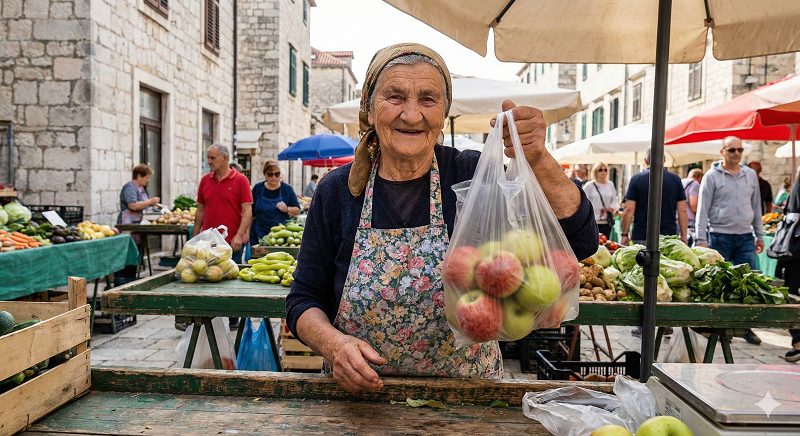
1. How to spot the “Real” Grandmas
The market is a mix of professional resellers and little old ladies (babas) selling what they grew in their garden.
- The Resellers: They have perfectly stacked pyramids of shiny apples, bananas, and pineapples. (Hint: Pineapples don’t grow in Croatia).
- The Babas: Look for the women with small, messy piles of vegetables. Their carrots might still have dirt on them. Their hands look like they have been working in soil. Buy from them. The flavor is 10x better.
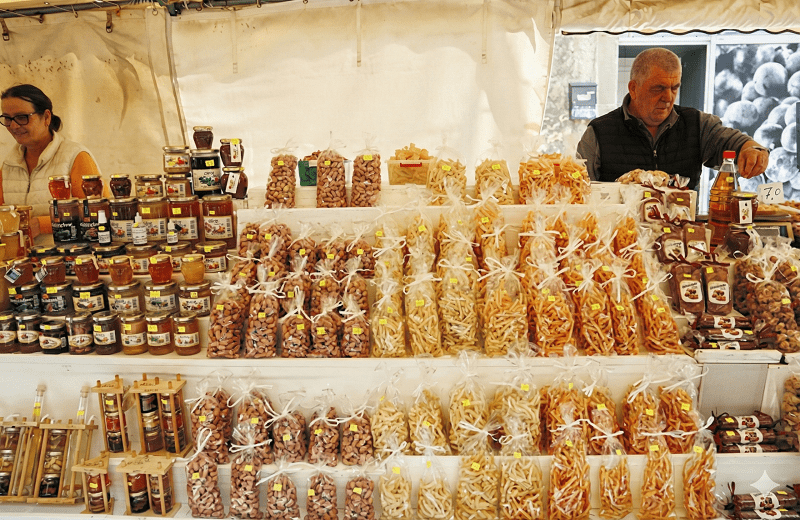
2. The “Holy Trinity” of Dalmatian Snacks
If you want to buy edible souvenirs to bring home (or eat in your hotel room), look for these three things:
A. Arancini (Candied Orange Peel) These are strips of orange peel boiled in sugar and dried. They are chewy, sweet, and bitter. They usually come in small clear bags for €3 – €5.
B. Sugared Almonds (Ušećereni bademi) Roasted almonds coated in a thick layer of crunchy sugar. Warning: They are addictive.
C. Dried Figs (Suhe smokve) Dalmatian figs are dried in the sun and often packed into “wheels” with bay leaves for flavor. They are the ultimate energy bar.
3. The Secret “Cheese Row”
Behind the fruit stalls, towards the back wall (near the Tommy supermarket), there is a row of stone counters. This is where the homemade cheese is sold.
- What to ask for: Paški Sir (Pag Island Cheese) is the most famous, but expensive. For something cheaper but delicious, ask for a mix of cow and sheep cheese (Miješani sir).
- Taste before you buy: You can always ask “Mogu probati?” (Can I try?). They will slice you a piece.
4. The Rules of the Market
- Cash is King: Do not even try to use a credit card here. Small bills (€1, €2, €5) are appreciated. If you hand them a €50 bill for a €2 bag of apples, you will get a very angry look.
- Don’t Squeeze the Peaches: In some countries, you pick your own fruit. In Croatia, the vendor usually serves you. If you start squeezing the tomatoes, you might get yelled at. Point at what you want, and let them bag it.
- Haggling: This is not a bazaar in Marrakesh. The price written on the cardboard sign is usually the price. You can maybe negotiate if you are buying 5kg of something, but generally, the price is fixed.
5. When to go?
- Best Selection: 7:00 AM – 9:00 AM. (This is when the restaurants buy their fish and veg).
- Best Deals: 12:30 PM – 1:00 PM. (Vendors want to clear their stock before they go home).
- After 2:00 PM: It’s a ghost town. The market closes early.
6. The “Other” Market: Peškarija (Fish Market)
Pazar is for veggies. If you want fish, you have to go to the Peškarija on the other side of the Old Town (near Marmontova Street).
- Fun Fact: It is the only fish market in the world with no flies. Why? Because it is built next to a sulfur spring, and the smell of sulfur keeps the flies away!
Want to taste the best of Split?
The market can be overwhelming if you don’t know the language. On this Food Tasting Walking Tour, you will start right next to the Pazar. The guide will show you exactly which stand sells the best almonds and introduce you to the history of the Silver Gate.


