
Quick Answer: Diocletian’s Palace, Split is a 4th-century Roman imperial complex covering the entire western half of Split’s Old Town. Built around 305 CE by Emperor Diocletian as his retirement residence, it spans 30,000 square metres and is a UNESCO World Heritage Site. Entry to the Palace itself is free and open 24/7 — but some sites inside require tickets. Approximately 3,000 people still live within its ancient walls today.
Most people arrive at Diocletian’s Palace expecting a ruin. They leave understanding why Split exists at all.
I lead walking tours through this Palace every day. And the thing I hear most often, at the end, is some version of this: “I had no idea. I thought it was just another old Mediterranean town.”
It isn’t. What you are walking through when you step inside these walls is one of the most important surviving examples of Roman imperial architecture anywhere in the world — and unlike virtually every other site of this scale, it never became a museum. People moved in 1,400 years ago and never left. There are families living here whose ancestors have occupied the same stone apartments for centuries.
This guide will tell you everything you need to know before you visit — the history, what to see, what things cost, and the details that don’t appear on the information boards.
What is Diocletian’s Palace?
Diocletian’s Palace in Split is not a palace in the way most people imagine — a grand building with halls and rooms you walk through. It is closer to a small fortified city. A rectangular complex roughly 200 metres by 240 metres, enclosed by walls up to 28 metres high, with four monumental gates, two main streets crossing at the centre, defensive towers, temples, a mausoleum, imperial apartments, and everything an emperor needed to live in secure retirement away from Rome.
It was built between approximately 295 and 305 CE, when Emperor Diocletian abdicated — becoming, remarkably, the only Roman emperor to voluntarily step down from power. He chose this location on the Dalmatian coast deliberately, near Salona (modern Solin), the city of his birth. He wanted to come home.
After Diocletian’s death the Palace passed through Roman, then Byzantine hands. Then, in the 7th century, the Roman city of Salona was destroyed by Avar and Slavic invasions. The survivors did what people have always done — they found the strongest walls they could and moved inside. Diocletian’s Palace became a refugee city. Houses were built inside temples. Streets were carved between ancient columns. The Palace stopped being a ruin and became a neighbourhood. It has been one ever since.
Who Was Diocletian — and Why Does He Matter?
Before you walk through the Palace gates, it helps to understand the man who built it.
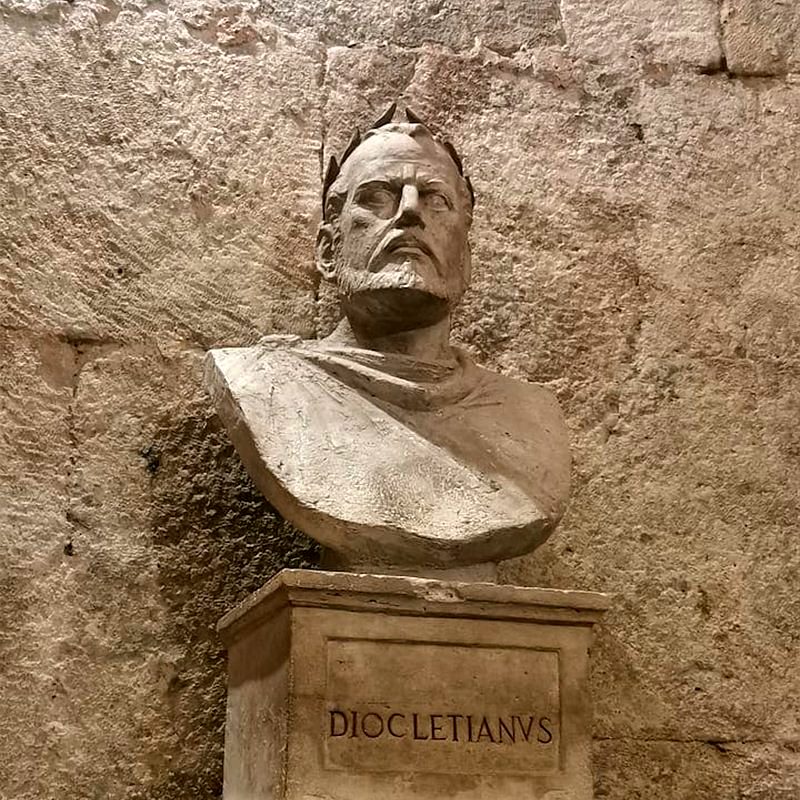
Gaius Aurelius Valerius Diocletianus was born in Salona around 244 CE to a family of modest means — possibly freed slaves. He rose through the Roman military entirely on ability, becoming Emperor in 284 CE at the age of around 40. He inherited an empire in crisis: decades of instability, military coups, economic collapse. What he did with it is remarkable.
Diocletian reorganised the entire Roman administrative structure, introducing the Tetrarchy — a system of four co-rulers that ended decades of civil war. He stabilised the currency. He reformed the military. He was, by most historical accounts, an exceptionally capable administrator — methodical, authoritative, and largely just. He had a strong sense of fairness that extended even to taxation: unlike many emperors who exempted Roman citizens, Diocletian made everyone pay equally. Romans included.
He was also the emperor responsible for the Diocletianic Persecution — the last and most systematic persecution of Christians in Roman history. He ordered churches burned, scriptures destroyed, clergy arrested and executed. Thousands died.
And then he abdicated. Retired to his palace on the Adriatic. Grew cabbages. Refused all requests to return to power. Died here around 312 CE.
History is rarely clean, and Diocletian is a good example of why. A man of genuine ability and fairness in many respects — and responsible for extraordinary cruelty in others. The Palace he left behind holds both of those things simultaneously.
Planning your Split Itinerary? Diocletian’s Palace is a 1,700-year-old maze, and the best hidden details aren’t on Google Maps. Don’t stress about navigating it on your own! Join my Essential Split Walking Tour and let me show you the hidden Roman secrets, the Game of Thrones cellars, and the best local spots in just 90 minutes. Spots are strictly capped at 12 people and sell out weeks in advance during summer. Check Availability For Your Dates Here →
The Four Gates: Where to Enter
The Diocletian’s Palace, Split has four gates, one on each side, each named for a metal in descending order of importance.
The Golden Gate (Porta Aurea) on the north side is the grandest — the ceremonial entrance, the one Diocletian used for formal processions. It faces the road that led to Salona, his birthplace. This is the gate I recommend entering first. Standing in front of it and looking up at the blind arcading and decorative niches gives you an immediate sense of the scale and ambition of what you are about to walk into. Just in front of the Gate, you’ll find the enormous statue of Bishop Gregory of Nin by Ivan Meštrović — rub his toe for good luck if you want, it’s traditional, but take a moment first to look back through the Golden Gate at the street outside. That view — ancient Roman stonework framing a modern Croatian city — is Split in one image.
The Silver Gate (Porta Argentea) on the east side opens into the daily market. Locals shop here every morning. This is one of the details that still surprises visitors: a 1,700-year-old Roman gate as the entrance to the vegetable market.
The Iron Gate (Porta Ferrea) on the west side leads toward the medieval part of the Old Town and the city square — Narodni trg, known locally as Pjaca.
The Bronze Gate (Porta Aenea) on the south side faces the sea and the Riva promenade. This was originally the waterfront entrance, where supply boats would dock. It now opens directly onto the promenade and is one of the most photographed spots in Split.
What to See Inside the Diocletian’s Palace Split
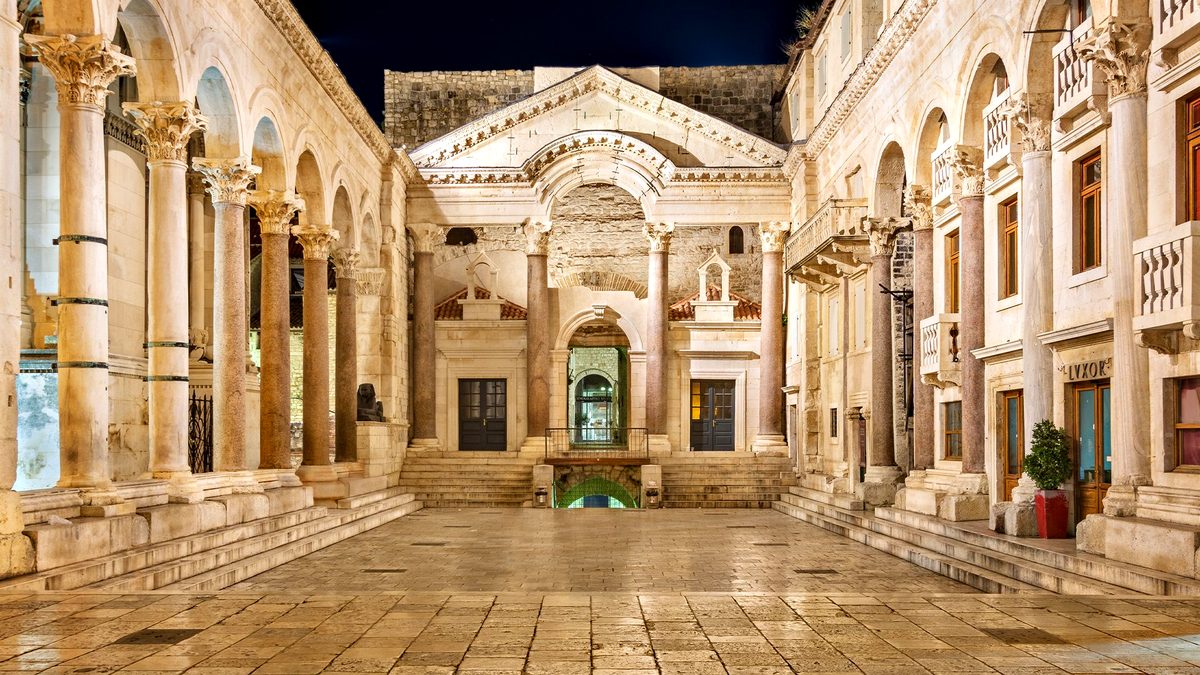
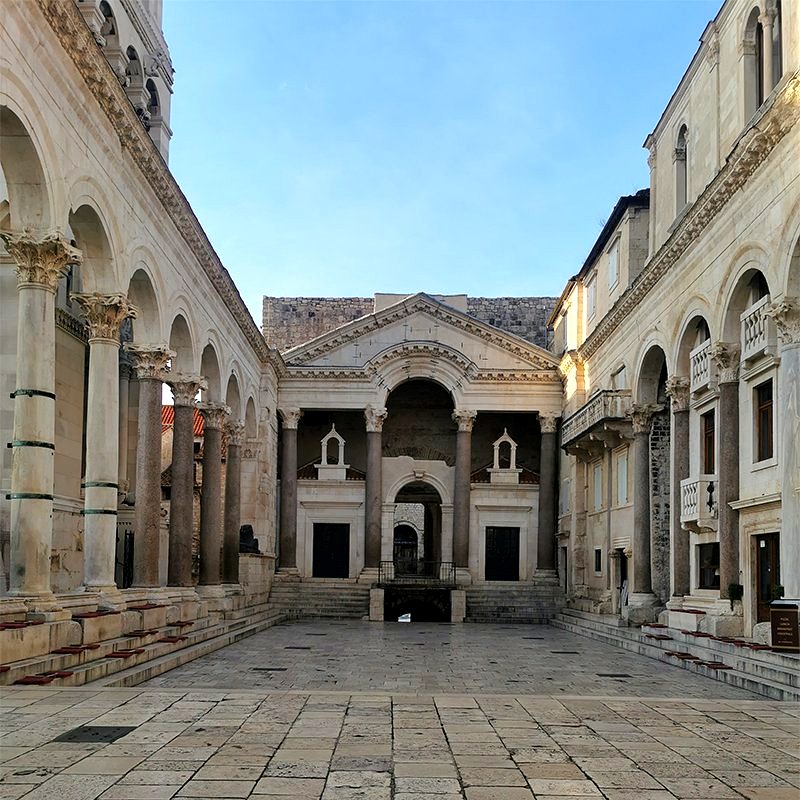
The Peristyle
The Peristyle is the ceremonial courtyard at the heart of the Palace — the place where Diocletian would appear before his subjects, elevated and robed, to be worshipped. Because he did consider himself divine. Specifically, he identified himself with Jupiter.
Today it is an open square surrounded by granite columns from Egypt, with café tables where people drink coffee and watch the world pass. On summer evenings there are concerts here. Children run across the same stone that Roman officials once crossed on their way to an audience with the Emperor.
Come early morning. Before 9am the Peristyle is often almost empty, and the quality of light on the stone columns — pale gold in the early sun — is extraordinary. This is the best time to photograph the entire Palace. By 10am in summer it will be full of tour groups.
The Cathedral of Saint Domnius
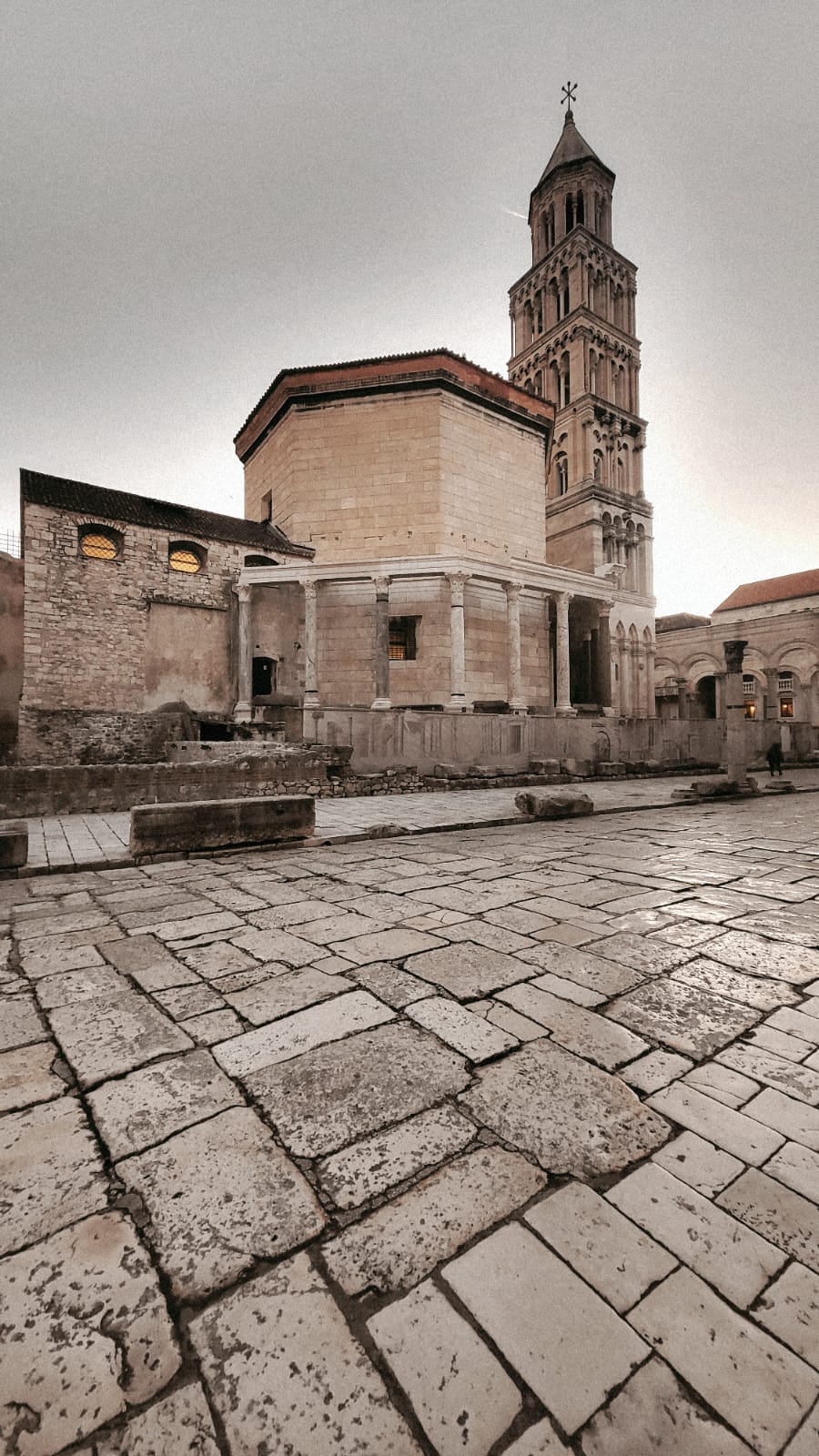
The Cathedral is, architecturally, one of the oldest in continuous use in the world. It was built as Diocletian’s personal mausoleum — the place prepared for his eternal rest.
He did not get to rest there.
After the Christian community established itself in Split, they converted his mausoleum into a church. They dedicated it to Saint Domnius — a bishop of Salona who had been martyred during Diocletian’s own persecution. The man who ordered the execution of Christians ended up buried in a building consecrated to one of his victims.
And his sarcophagus? Thrown out to make room for the altar.
I have told this story hundreds of times on tour and the reaction is always the same — a kind of disbelieving laugh. It is one of history’s more complete ironies.
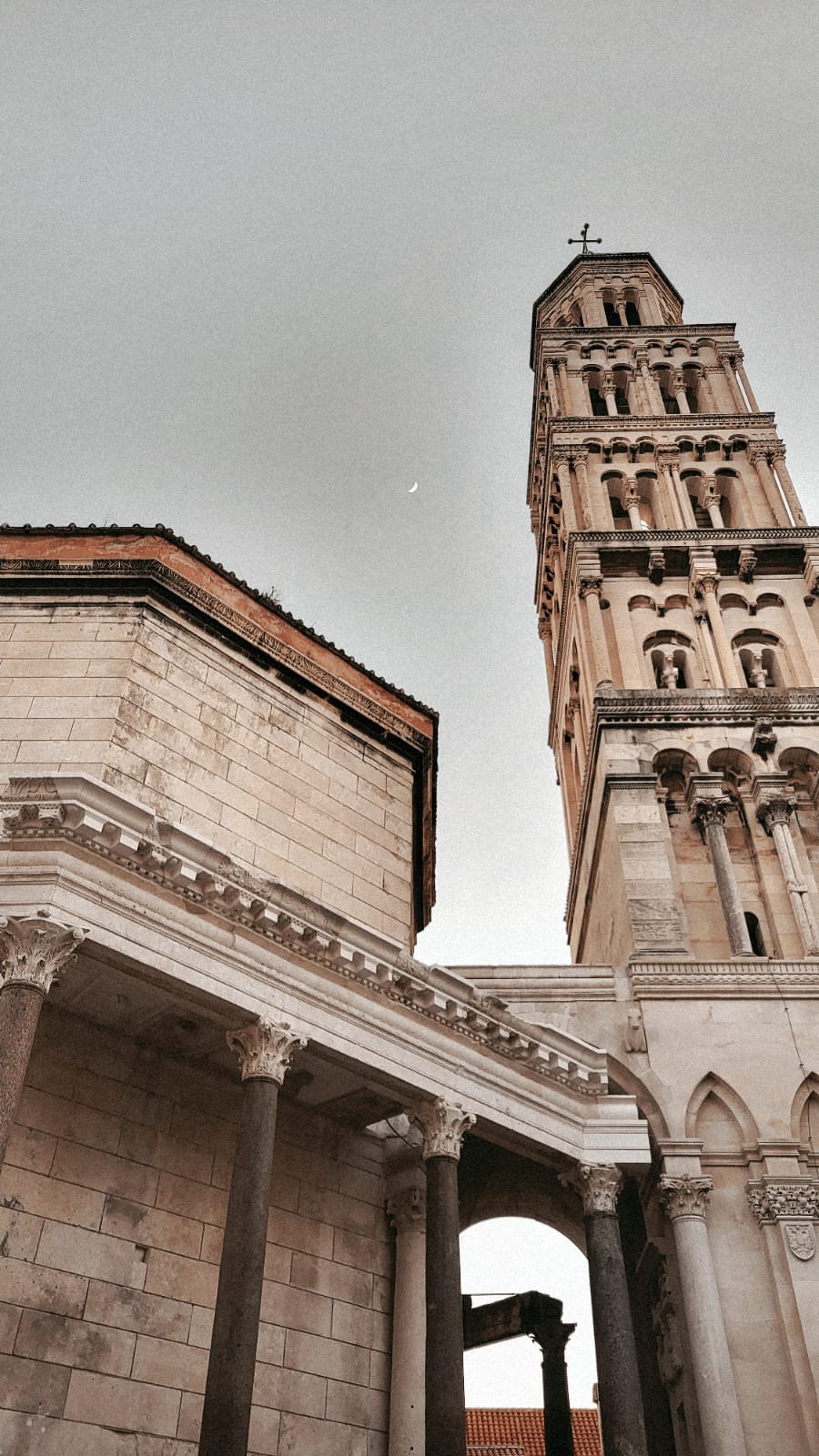
The Cathedral is worth entering. The interior layers of Roman, Romanesque, and Gothic elements tell the entire history of Split in one room. The 13th-century carved wooden doors by Andrija Buvina are particularly remarkable — 28 panels depicting scenes from the life of Christ, in extraordinary condition for their age.
Climb the Bell Tower if your knees allow it. The views over the Palace rooftops, the harbour, and Marjan Hill are the best elevated perspective on Split you will find.
Jupiter’s Temple
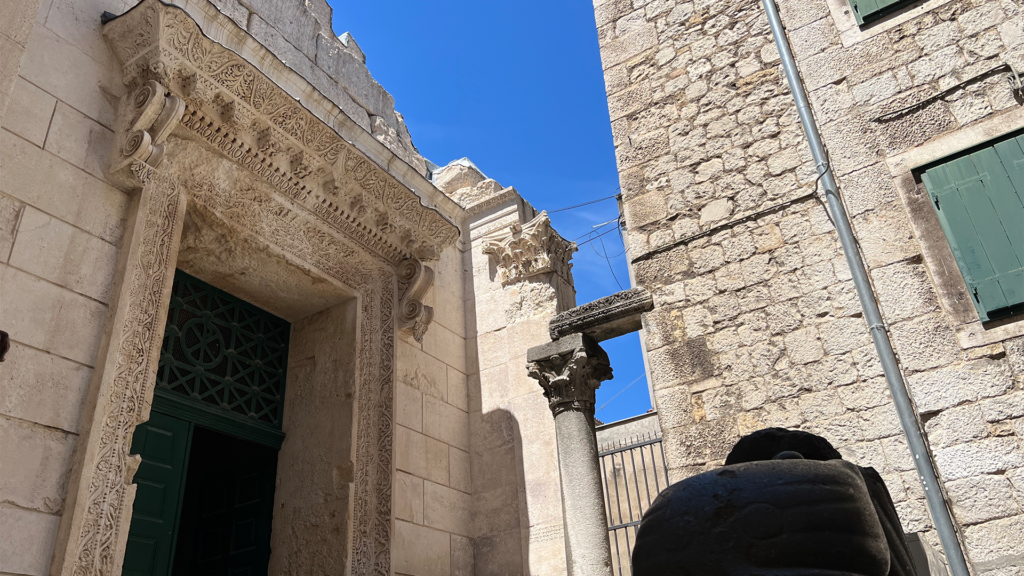
Tucked in a narrow alley a few steps from the Peristyle, the Temple of Jupiter is easy to walk past without noticing. Don’t.
It is one of the best-preserved Roman temples anywhere in the world, now converted — following the pattern established by the Cathedral — into a Christian baptistery. The coffered barrel vault above you is Roman. The Romanesque baptismal font in the centre is medieval. The headless sphinx in the doorway came from Egypt with Diocletian’s construction materials, around 1,800 years ago.
The combination ticket for Cathedral, Bell Tower, Treasury and Jupiter’s Temple is the best-value option if you plan to visit all four.
The Underground Cellars
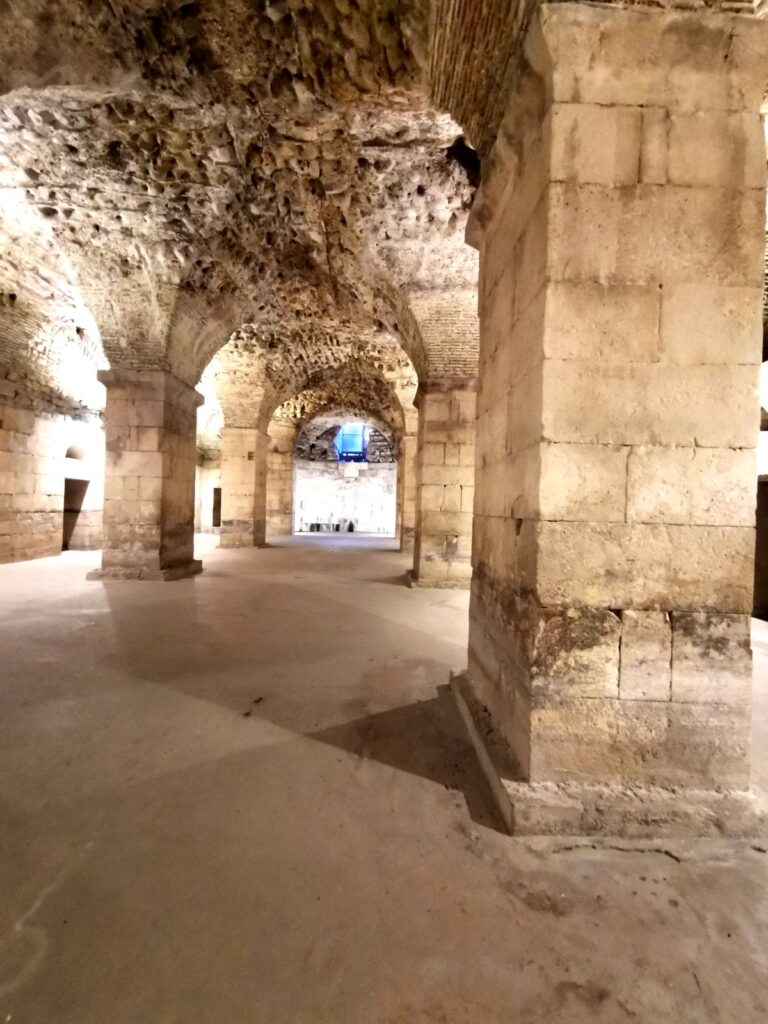
The Cellars — the substructures beneath the imperial apartments — are the most complete surviving record of the Palace’s original layout. The apartments above ground were recycled, built over, and transformed beyond recognition over fourteen centuries. The cellars beneath them were simply filled in and forgotten, which is why they survive in almost their original form.
They were rediscovered in the 19th century, and excavations have continued in various phases ever since. Walking through them gives you the clearest sense available of what the Palace originally looked like — the proportions, the vaulted spaces, the Roman construction methods.
Yes, Game of Thrones fans will recognise them. The central hall served as Daenerys’s throne room in Meereen. It’s a remarkable location for a dragon pit, it must be said.
Pay the entrance fee. The free section at the entrance gives you a taste but the full cellars, including the deeper excavated areas, are worth it. Allow 30-45 minutes.
The Street Called “Let Me Pass”
If you walk the main east-west street through the Palace — the Decumanus — and turn into the residential alleys next to Jupiter’s Temple, you will find a passageway so narrow that locals named it simply: Pusti me proć — “Let me pass.”
Most tourists never find it as there is no street sign. It is easy to miss entirely if you are following a map or staying on the main routes. But it is one of the details that captures something essential about the Palace — that this is a real neighbourhood, with real spatial constraints, where real people have been navigating the same tight corners for centuries.
Finding it is part of the reward. Ask a local for directions if you’re struggling.
The Diocletian’s Palace, Split as a Neighbourhood: What Living Here Actually Looks Like
There is a version of this story that gets told with a kind of romantic gloss — “people still live inside a Roman palace, isn’t that charming.” The reality is more complicated and more interesting.
Through much of the 20th century, the interior of the Palace was not charming at all. The residential areas — densely occupied, poorly maintained, without proper infrastructure — were known locally as a rough neighbourhood. Through the 1980s and 1990s, parts of the Palace interior were associated with drugs, alcohol, and crime. Tourists were informally advised to avoid certain alleys at night. It was Split’s getto — the word locals actually used.
What happened since is a story of gradual transformation through tourism and investment. Apartments were renovated. Restaurants and galleries moved in. The neighbourhood became desirable. Today it is one of the most sought-after addresses in Croatia.
But the old Split families are still there. You will see laundry hung between Roman columns. Cats sleeping on ancient stone steps. A ground-floor apartment with a television visible through a window set into a 4th-century wall. Children being called in for dinner by a parent leaning out of a window that Diocletian’s household staff once used.
This is what separates Split from every other Roman site in the world. It was never preserved. It was lived in, continuously, for 1,700 years. And that continuity — messy and unromantic and entirely real — is what makes it extraordinary.
Practical Information
Entrance to the Palace: Free, open 24/7
Underground Cellars: Open daily. Purchase tickets at the entrance on the south side (near the Bronze Gate / Riva). Recommended — worth the fee.
Cathedral of Saint Domnius + Bell Tower + Treasury + Jupiter’s Temple: Combination ticket available and best value. Check current prices at the Cathedral entrance on the Peristyle.
Best time to visit: Early morning — before 9am if possible. The Peristyle in the early light without crowds is a genuinely different experience from the same space at midday in summer.
Best photo spot: The Vestibule — the circular domed room immediately south of the Peristyle, which served as the entrance to Diocletian’s private apartments. Look up. The open oculus at the top of the dome frames a circle of sky that has been unchanged for 1,700 years. Most tourists glance at it and move on. Stop, look up, and let it register properly.
How long to allow: 2 hours minimum to see the main sites at a reasonable pace. Half a day if you include the Cellars, the Cathedral tower climb, and time to sit at a Peristyle café.
Getting there: The Palace is the centre of Split. Walk from anywhere in the Old Town, from the ferry port, or from the bus station. All are within 10-15 minutes on foot.
The Honest Reason to Take a Guided Tour
You can walk through Diocletian’s Palace, Split on your own. The main sites are signed, the Cellars have information panels, and the basic facts are available on a dozen websites including this one.
What you will not get on your own is the sense of why any of it matters.
Most visitors who walk through unguided spend an hour, take some photos, and leave with a vague impression of old columns. They don’t understand how Diocletian’s abdication was unprecedented in Roman history. They don’t know why the Cathedral is dedicated to a man Diocletian had executed. They don’t see the Street Called Let Me Pass. They don’t know what the neighbourhood looked like thirty years ago, or what the archaeological excavations currently underway might still be uncovering.
Context turns stone into story. That is what a good guided tour provides — and in a place with as many layers as Diocletian’s Palace, the context is the entire point.
Context turns stone into story. That is what a good guided tour provides — and in a place with as many layers as Diocletian’s Palace, the context is the entire point.
Skip the massive 30-person umbrella tours. Join my small-group (max 15 people) experience to see Split like a true local.
Jelena Tanjić is a licensed tour guide based in Split, Croatia and the founder of KUKUVIA. She leads small-group walking tours of Diocletian’s Palace and Split’s Old Town daily.
→ Book the Essential Split Walking Tour → Read more Split travel guides
Further reading: UNESCO World Heritage — Diocletian’s Palace & Historic Split
Is Diocletian’s Palace, Split free to visit?
Yes — entry to the Palace complex itself is free and open 24 hours. Specific sites inside (the Underground Cellars, Cathedral, Bell Tower, Jupiter’s Temple) charge separate entrance fees.
How much time do you need at Diocletian’s Palace, Split?
At minimum 1-1.5 hours to see the main highlights. 2-3 hours if you include the Cellars and Cathedral Bell Tower climb. Half a day if you want to explore properly.
Is Diocletian’s Palace, Split worth visiting?
Yes, without question. It is one of the best-preserved Roman imperial complexes in the world and the most unusual — a living neighbourhood where people still live, work, and eat within 4th-century walls. There is nothing else quite like it anywhere.
What is the best time to visit Diocletian’s Palace, Split?
Early morning — before 9am — for the best light, fewest crowds, and the most atmospheric experience of the Peristyle. In summer, by 10am the main areas are busy with tour groups.
Do I need to book a tour of Diocletian’s Palace, Split in advance?
For the Underground Cellars, buying tickets online in advance is recommended in peak summer (July-August) as queues can be long. For guided walking tours, advance booking is recommended to secure your preferred time.
Was Diocletian’s Palace, Split used in Game of Thrones?
Yes — the Underground Cellars were used as filming locations for the fictional city of Meereen in seasons 4 and 5. The central vaulted hall served as Daenerys’s throne room.


